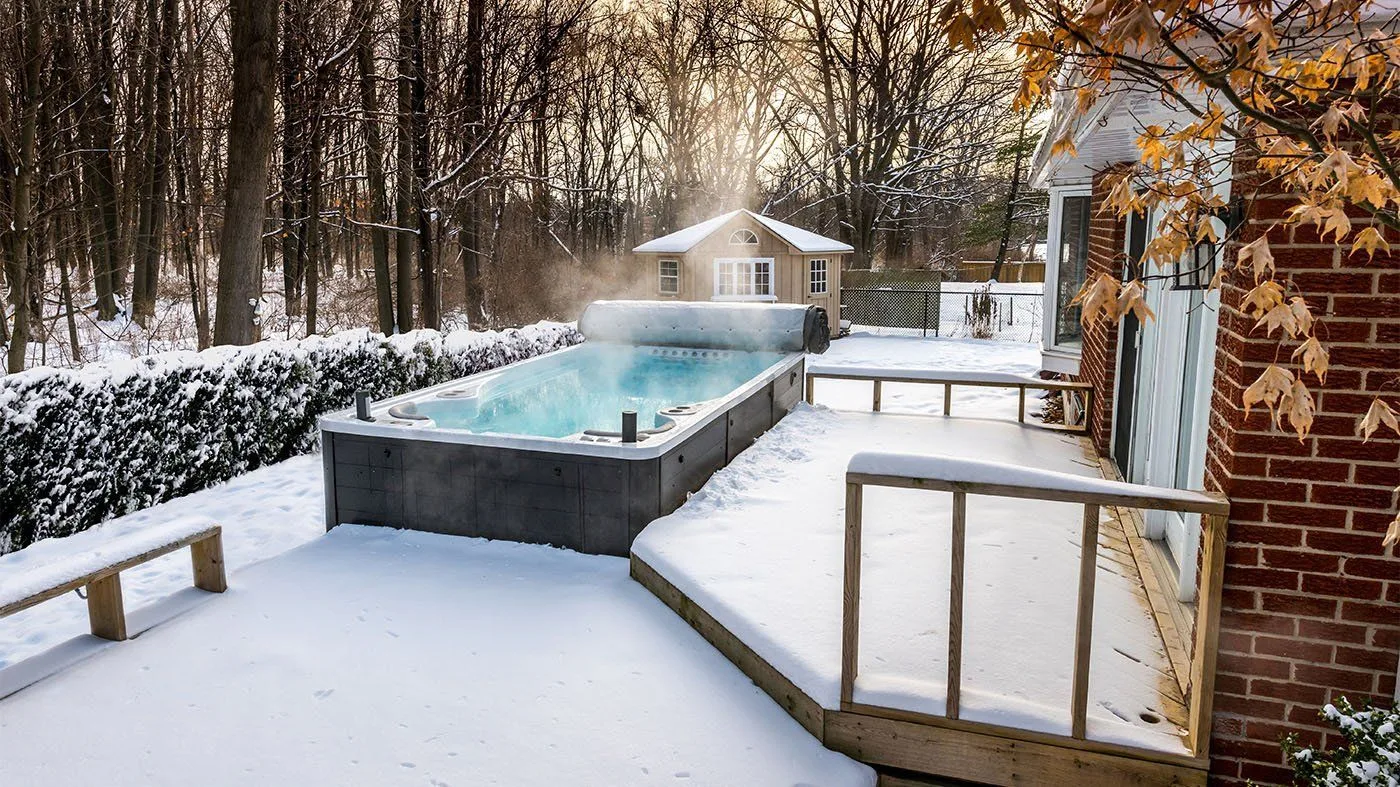
The question behind every swim spa conversation in this province: what does winter really do to the operating cost? The honest answer has two parts. Yes, holding a few thousand litres warm through a New Brunswick January takes real energy — and no, it is not a mystery or a runaway bill. It is a short list of factors, most of them manageable, all of them worth understanding before you buy rather than after.
TL;DR
- Winter energy use is dominated by heat loss, and heat loss is dominated by the cover and insulation architecture.
- Your chosen water temperature is the biggest lever you control — every degree of setback helps, and swim temperature is naturally cooler than soak temperature.
- Wind exposure, cover discipline and filtration scheduling are the everyday tools for managing consumption.
- The engineering premium of a cold-climate build pays its rent in exactly these months.
- Ask us to walk through real owner experiences for the model you're considering — in the showroom, beside the machine.
The Physics, in One Paragraph
A swim spa in January is a heat budget: energy in must equal heat escaping through the cover, shell, floor and cabinet. Everything about winter operation follows from that. The cover carries the largest share, insulation architecture sets the baseline, wind accelerates losses, and every degree of water temperature widens the gap the heater must fill. The machine's job — and the reason cold-climate engineering exists — is to make each of those leaks as small as physics allows.
Temperature Strategy: The Lever You Own
Swim spas have a built-in winter advantage over hot tubs: their working temperature is cooler. Water comfortable for exercise sits well below soak temperature, and that difference alone meaningfully shrinks the heat budget. Owners refine from there — training temperature on swimming days, a modest setback during away stretches, warmer holds only when the family wants play sessions. Dual-zone models let the small hot tub end run hot while the big swim volume stays economical, which is the efficient way to have both.
Cover Discipline and Wind Shelter
The two habits that separate economical winters from expensive ones: keep the cover healthy (dry, well-fitting, promptly repaired — a waterlogged cover on this much surface area is a serious leak) and closed whenever the water is idle; and take wind seriously at siting time, because a sheltered pool simply runs easier than an exposed one. Neither habit costs anything once the install is planned well — which is why the site conversation before delivery matters so much on these machines.
Honest Expectations, Before You Buy
We would rather set expectations in the showroom than manage surprises in February. Winter operation costs more than summer operation; a swim spa costs more to run than a hot tub; and both facts are the price of a heated swim lane in a province where every other pool is closed seven months a year. What we can do — beside a filled, running pool — is walk through what owners of your shortlisted model actually experience through a winter, how settings change the picture, and whether the value fits your family. If it doesn't, we will tell you that too; a swim spa that disappoints its owner helps nobody, least of all us.
New Brunswick Perspective
For the cost-factor deep dive that applies to any insulated vessel in this climate — cover condition, insulation architecture, siting, settings — our hot tub electricity article covers the same physics at smaller scale. The swim spa version of the story differs only in size and in one pleasant twist: swimming temperature is cheaper to hold than soaking temperature, so the machine you exercise in is gentler on the budget than its volume suggests.
Frequently Asked Questions

Flexible Payments on Any Arctic Spas Hot Tub
Take advantage of the most competitive financing rates through FinanceIt. Apply online in minutes and get a fast decision - no pressure, no commitment.
Visit a Poolboy Showroom in New Brunswick
Our team in Fredericton and Moncton can answer your questions, show you the full Arctic Spas lineup, and help you find the right fit for your home.